- Equity Code :832537

In most baghouse discussions, filter media gets treated as a fixed component rather than a variable worth optimizing. In practice, the fabric itself is one of the biggest determinants of filtration efficiency, pressure drop, and service life. This article looks at how filter media actually works, what factors shape its real-world performance, and how to approach media selection more deliberately.
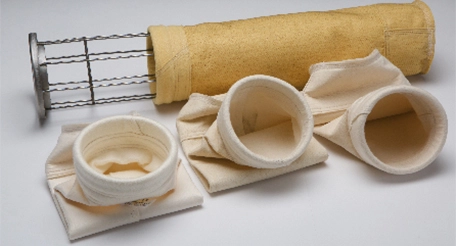
Woven fabrics rely primarily on surface filtration: dust builds up as a cake on the fabric surface, and this cake layer becomes the main filtering mechanism over time. Needle-felt (non-woven) media, by contrast, relies more on depth filtration, trapping particles within the fiber matrix itself. This structural difference affects everything from initial efficiency to how the media behaves as it ages.
Common fiber types include polyester, acrylic, fiberglass, aramid, and PTFE-based fabrics, each with different temperature limits and chemical resistance profiles. Choosing the wrong fiber for the operating environment is one of the most common causes of premature filter failure.
Membrane-laminated media adds a thin, highly porous layer to the fabric surface that captures fine particles more effectively while often reducing pressure drop compared to untreated media, though typically at a higher upfront cost.
General-purpose use, moderate temperature resistance, cost-effective for most standard dust applications.
Higher temperature tolerance, often chosen for hot gas streams such as those in cement or steel processes.
Strong heat resistance combined with good durability, suited to demanding continuous-duty environments.
Excellent chemical resistance and fine particle capture, commonly used for demanding or corrosive conditions.
Denser fiber packing and smaller pore sizes improve particle capture but increase initial resistance to airflow. Media selection often comes down to finding the right balance between capture precision and acceptable pressure drop for the application.
Operating above a media's rated temperature limit, even intermittently, can cause embrittlement, shrinkage, or outright failure of the fabric well before its expected service life is reached.
Acidic or alkaline gas streams can chemically degrade certain fiber types over time, weakening the media well before mechanical wear becomes the limiting factor. Matching fiber chemistry to gas composition is essential in these environments.
Sticky or highly fine dust behaves very differently on the filter surface than dry, coarse particulates, and often benefits from specific surface treatments designed to prevent buildup or blinding of the media.
Select fiber type and surface treatment based on real gas temperature, chemical composition, and dust characteristics — not solely on unit price, which rarely reflects total operating cost.
A steadily rising pressure drop is often the clearest early signal that filter media is approaching the end of its useful life, allowing replacement to be planned rather than reactive.
Membrane-laminated or higher-grade media typically costs more initially but can reduce energy consumption and extend service intervals in fine-particulate applications, often lowering total cost over the equipment's lifespan.
Filter media is not a standardized part that performs the same way regardless of context — it is one of the most influential variables in your baghouse's long-term efficiency and operating cost.
Contact our engineering team to review your operating conditions and identify the filter media best suited to your process.